
We are ready to talk but will not accept any condition now," said a farmer's leader.

Farmer leader Kanwalpreet Singh Pannu said that thousands of farmers will start their 'Delhi Chalo' march from Rajasthan's Shahjahanpur through the Jaipur-Delhi Highway at 11 am on Sunday.

Standing by his cycle, the 36-year-old from Punjab Moga's district said he could have taken a bus or a train to Delhi, but that could mean his family would have to go hungry.

Farmers gathered at several national highways, key roads and some railway tracks in Punjab and Haryana on Friday morning as part of their nationwide protest against the Centre's new agri laws.

The farmers' tractor rally - Kisaan Parade - against the farm laws was expected to be held after 12 pm. However, huge crowds gathered on the borders at around 8 am.

Farmers said the government should have formed a committee of farmers and others before the laws were enacted by Parliament.

"They have put these barbed wires, not us. They are not allowing people to come to Delhi. We are not the one blocking the roads. If we block roads, they ask us to vacate, but no action is taken when the same is done by these security forces," said.
November 26 would mark one year of the ongoing farmers' protests at Delhi's border points of Singhu, Tikri and Ghazipur.

The Delhi police's Special Cell has lodged an FIR under sections of the Unlawful Activities Prevention Act (UAPA) and sections of the IPC dealing with sedition to investigate the violence at Red Fort in Delhi on January 26.

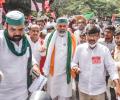
Here are some of the key farmer leaders who fronted the protests.

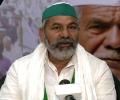
"They did business of temple, religion and feelings. Now, they want to do the business on hunger," Tikait alleged.

The Indian High Commission made its displeasure known despite the British government earlier reiterating that the three New Delhi laws on agricultural reform were a "domestic matter".

Farmer leaders on Monday started their day-long hunger strike against the Centre's new farm laws and said protests will be held at all district headquarters later in the day, even as more people are expected to join the ongoing agitation at Delhi border points.

The farmers threatened to intensify their agitation and block more roads if the government did not accept their demand.
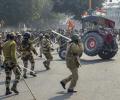
An FSL team had visited the Red Fort on Saturday and Ghazipur protest site on Friday.

The Delhi police had on Saturday increased security arrangements by deploying additional personnel and placing more concrete barriers.

The report, which was submitted to the apex court on March 19, 2021, was made public on Monday. The three-member committee had also suggested many changes in the laws, including giving freedom to states to make Minimum Support Price (MSP) system legal.

The Delhi government has approved the withdrawal of 17 cases registered during the anti-farm law stir, including one involving last year's Republic Day violence, a senior official said on Tuesday.
These "kisan mahapanchayat" are scheduled to be held in Haryana's Karnal, Rohtak, Sirsa and Hisar districts, and Maharashtra's Akola and Rajasthan's Sikar, he said.

'If banging thalis could drive corona as Modi said, banging thalis will drive away the farm laws.'

Tikait has been at loggerheads with various governments on a range of farmers' issues, including loan waivers, minimum support price, power tariff and land acquisition in states such as UP, Haryana Rajasthan, Madhya Pradesh.

Wearing garlands, the farmer leaders, who had called for observing 'Sadbhavana Diwas' (Harmony Day) on Saturday after the immense outrage over violence by protesters during their Republic Day tractor rally, sat on the dais during the fast, as crowds of supporters swelled, especially in Gazipur where the Bharatiya Kisan Union is leading the protest.
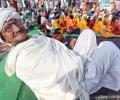
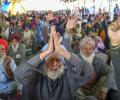
Thousands of farmers, mostly from Punjab, Haryana and western Uttar Pradesh, have been camping at the Delhi border points --- Singhu, Tikri and Ghazipur --- for over four months, demanding the repeal of farm laws and a legal guarantee on the minimum support price for their crops.

Protesting farmers owing allegiance to different farmers' bodies blocked state and national highways at several places on Saturday, causing inconvenience to commuters.

The farmers lifted blockades on highways at Singhu, Tikri and Ghazipur borders and took out a 'Victory March' to celebrate the repeal of three contentious farm laws and the Centre's written assurance to fulfil their other demands, including constituting a committee for legal guarantee on minimum support price (MSP) for crops.
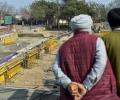
Land plots filled with wild grasses near Ghazipur, Tikri and Singhu protest sites have been converted into well-curated nurseries with a variety of flowers like marigold and rose.
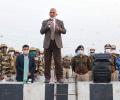
Union Home Minister Amit Shah on Thursday had a meeting with Delhi Police Commissioner S N Shrivastava, ahead of the 'chakka jam' announced by farmer unions protesting against the three agri laws at Delhi's borders, sources said.
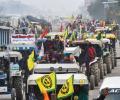
Robust procurement of paddy and wheat since 2017 and prompt payment to farmers have helped the UP government cultivate a positive and pro-farmer perception, defusing possible farm face-off situations.
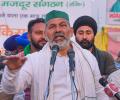
'The demands are also the same -- all three 'black' farm laws should be repealed, a new law made to ensure MSP (minimum support price) for crops'

The farmers' agitation, which has entered its fourth week, has also led to traffic diversions at various border points causing inconvenience to commuters.

The Delhi Traffic Police took to Twitter to inform commuters about alternative routes open for travelling to the neighbouring states of Uttar Pradesh and Haryana.

Thousands of farmers, especially from Punjab and Haryana, have been camping at various border of Delhi for almost four weeks now as formal talks between the government and representatives of farmers' unions remained deadlocked with protesting peasants refusing to accept anything less than a repeal of the newly enacted laws.

From carrying portraits of their sons and husbands who have committed suicide due to agrarian distress to picketing to doing sewa 24x7 at langars, women have shown a rare determination not to capitulate before the government.
'Have you seen a situation like this anywhere before, globally or in India, where a government says, okay, we are withdrawing a law because you don't want it?'

Before bidding farewell to Singhu, some farmers performed havans and sang kirtans, and some danced to bhangra songs to mark the day as 'Vijay Diwas'.

The dilemma is that if farming is to be efficient, farmers will be worse off -- and if farmers are to be better off farming will be worse off, reveals T C A Srinivasa-Raghavan.

The protesting farmers, mainly from Punjab, Haryana and western Uttar Pradesh, have been at the border points of the national capital for almost 40 days now, braving the bone-chilling cold weather in the region.

Some groups of farmers started going back to their respective sit-in sites on Tuesday evening after hours of chaos during their tractor parade against the farm laws, but thousands of other protesters were still in several areas, including ITO, Nangloi and Mukarba Chowk, of the national capital.

Ahead of their proposed tractor parade on Republic Day, protesting farmer Unions Monday announced they will march towards Parliament from different locations on February 1 when the annual Union Budget is scheduled to be presented.
The Samyukt Kisan Morcha, an umbrella body of the farmer unions protesting the three farm laws, said emergency and essential services such as ambulance and school bus will not be stopped during the 'chakka jam' that is proposed to be held between 12 pm and 3 pm.
 © 2026 Rediff.com - Advertise with us - Disclaimer - Privacy Policy - Sitemap - Feedback - About us - Terms of use - Grievances